Solving Condensation Sweating, Mold Spoilage & MAP Leaks in Flatbreads
Eliminate 72-hour bag fogging and mold spots by auditing loaf core cooling (<32 °C), post-oven HEPA clean air, 60/40 CO2/N2 MAP gas flushing, and box-motion.
Why Warm Bread + Sealed Plastic = Guaranteed Mold in 4 Days
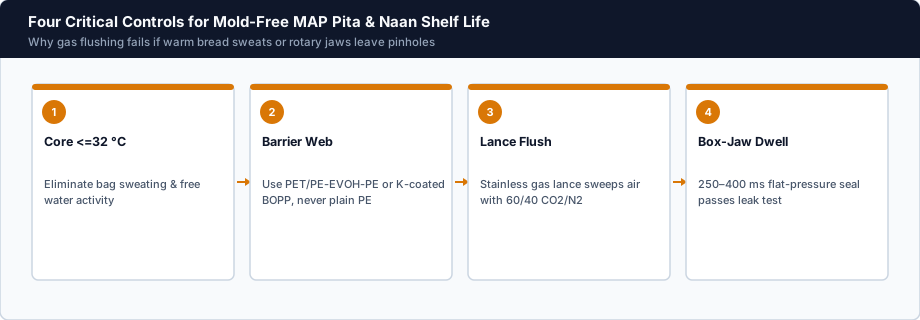
Pita exits a 400–500 °C tunnel oven completely sterile inside—every single mold spore (Aspergillus, Penicillium, Eurotium) lands on the loaf during open-air cooling and manual counting! If bread is sealed above 32–34 °C core temperature, internal crumb moisture migrates outward and condenses into liquid droplets (Aw -> 0.99 locally) against cool retail film walls, germinating spores even if calcium propionate was added in dough.
Grounded in bakery sizing and shelf-life planning and map shelf-life and bakery film specs, follow this five-point bakery checklist to hit 21–45+ days cleanly.
Five-Point Flatbread Mold & Staling Root-Cause Matrix
Diagnostic guide for commercial pita, naan, and tortilla quality teams:
| Spoilage Symptom | True Physical Root Cause | Engineered Fix |
|---|---|---|
| Water droplets inside bag @ 2 hours | Core temp >34 °C at wrapper infeed | Extend spiral cooler dwell to <=28–31 °C + IR temp gate |
| Green/white mold @ Day 5–7 | Airborne flour spores + hand counting | Filtered positive-pressure cooling room + optical stacker |
| Mold inside ‘MAP’ packs @ Day 10 | Pinholes at fin-crimp T-junction OR BOPP film | Switch to box-motion jaws + EVOH/PVDC barrier film |
| Bag sucked flat / crushed pockets | >80% CO2 absorbed into moist bread | Rebalance mixer to 50–60% CO2 + 40–50% N2 cushion |
| Dry brittle pita rims @ Day 4 | High-WVTR thin LDPE or leaky clip neck | Upgrade to 30–35 μm BOPP (3.9–6.2 WVTR) or heat-seal |
Inspect hermetic long-dwell machinery in box-motion MAP flow wrappers.
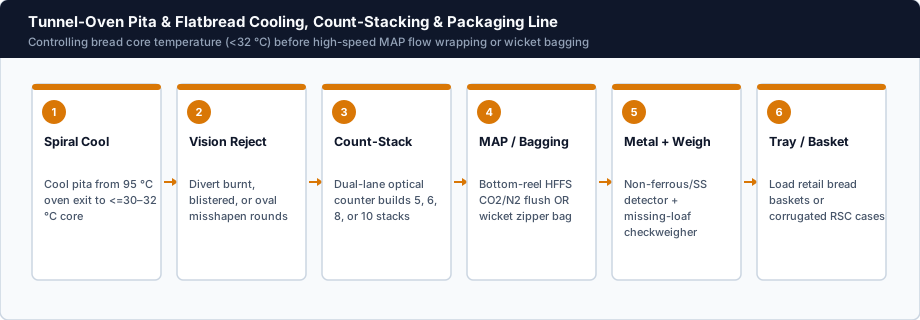
Flatbread & Bakery Engineering Notes
- Submerge 3 Packs Every Hour in a Vacuum Tank: Place a transparent
-0.06 to -0.08 MPawater bubble-test chamber beside the wrapper—a stream of tiny bubbles from the center back-fin junction reveals jaw pressure drift weeks before retail mold returns arrive. - Sanitize Cooling Belts & Slicers/Stackers Without Water Traps: Dry HEPA vacuuming + 70% food-grade alcohol misting on PU belts beats high-pressure water hosing that sprays wet flour paste onto ceiling rafters.
- UV-C Tunnel Over the Cooler Discharge: Shielded 254 nm UV-C lamps over the final 2 meters of cooling conveyor and packaging infeed knock down surface airborne mold counts before wrapping.
Audit Your Shelf-Life Bottleneck With Our Bakery Team
Share your current cooling temp, film structure, and shelf-life days via Project Brief.
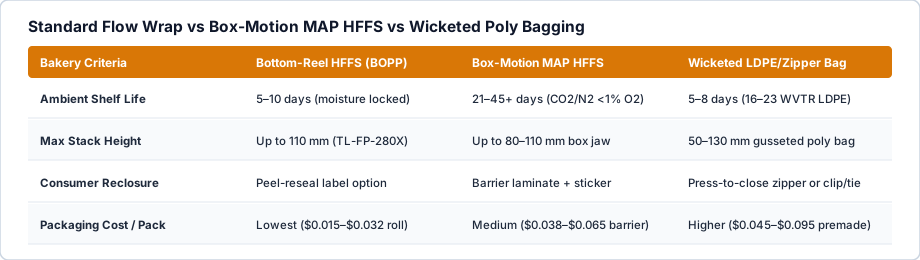
Explore related bakery equipment in Pita Packaging Machines, MAP & Bakery Film Specs, or send your loaf diameter & stack height via Project Brief.
Related Specifications
Further Reference
Verify Dimensions & Operating Ratings
Send your target envelope, load requirements, and ambient environment to review matching configurations.